New model
Own research
This is based mostly on findings of polyphasic sleepers and own research; this model of sleep is not established scientific consensus.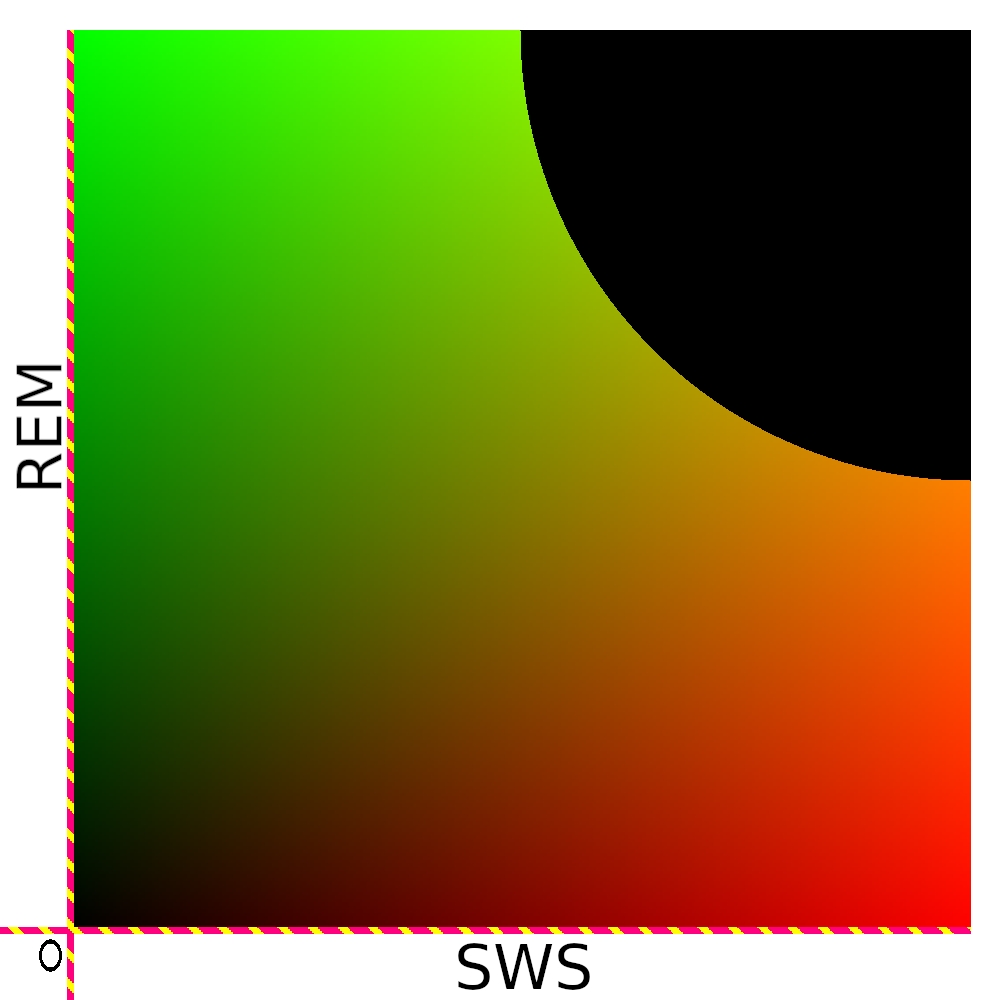 The "new model" is a model of sleep based on a two-dimensional
state space of sleep, instead of distinct stages.
The "new model" is a model of sleep based on a two-dimensional
state space of sleep, instead of distinct stages.
One axis represents the same thing as conventional NREM depth (see deepening); what is called SWS in conventional terms is anything that is beyond a certain value on this axis, before that comes NREM2 light-sleep, etc.
The other axis represents REM depth. Usually REM in monophasic sleep is quite shallow, but e.g. a dawn nap in monocore schedules tends to contain significantly deeper REM.
None of these are so far unproven or particularly unconventional. NREM being a continuum is mostly accepted consensus, REM being one is not really researched as far as I could find, but strongly indicated by various observations and does not go against anything we know.
However, the two being axis on a graph is somewhat controversial as it indicates a possible state where NREM sleep takes place along with REM sleep, which even by naming sounds somewhat paradoxical. There are however indications for this being possible:
- Delta wave power (usually seen during NREM sleep) can happen in REM according to some EEG recordings
- Naps tend to relieve both REM and NREM pressure, even when they are e.g. dawn naps
- Dreaming can occur during what is usually defined as SWS or light sleep
Axis naming
In the shown diagram, the axis are called REM and SWS. However, if this model becomes adopted further and proven, it would make sense to rename them to something more fitting based on what they indicate. The SWS axis might be called "Delta power", "Slow wave strength", "Deepness", or possibly "Physical recovery". The REM axis might be called "Thinking"/"Dreaming", "Activity", "Alpha power"/"Alpha wave strength", or possibly "Mental recovery"Sleep spindles
A problem with this model so far is that it does not consider sleep spindles, and might not sufficiently consider K-Complexes.K-Complexes are treated here as essentially a form of delta waves. Both seem to suppress awakening / stimulus response, both are in the same frequency band and tend to have relatively high amplitude. K-Complexes also seem to precede higher "background" delta wave amplitude.
Spindles however have surprisingly little (or hard to find) research that links them to anything. We know they are observed in NREM2 light-sleep, but it is very hard to find data on spindles in SWS or REM. If these do not exist, the new model might not accurately reflect reality - but there is also no data on them not existing. More data is needed.